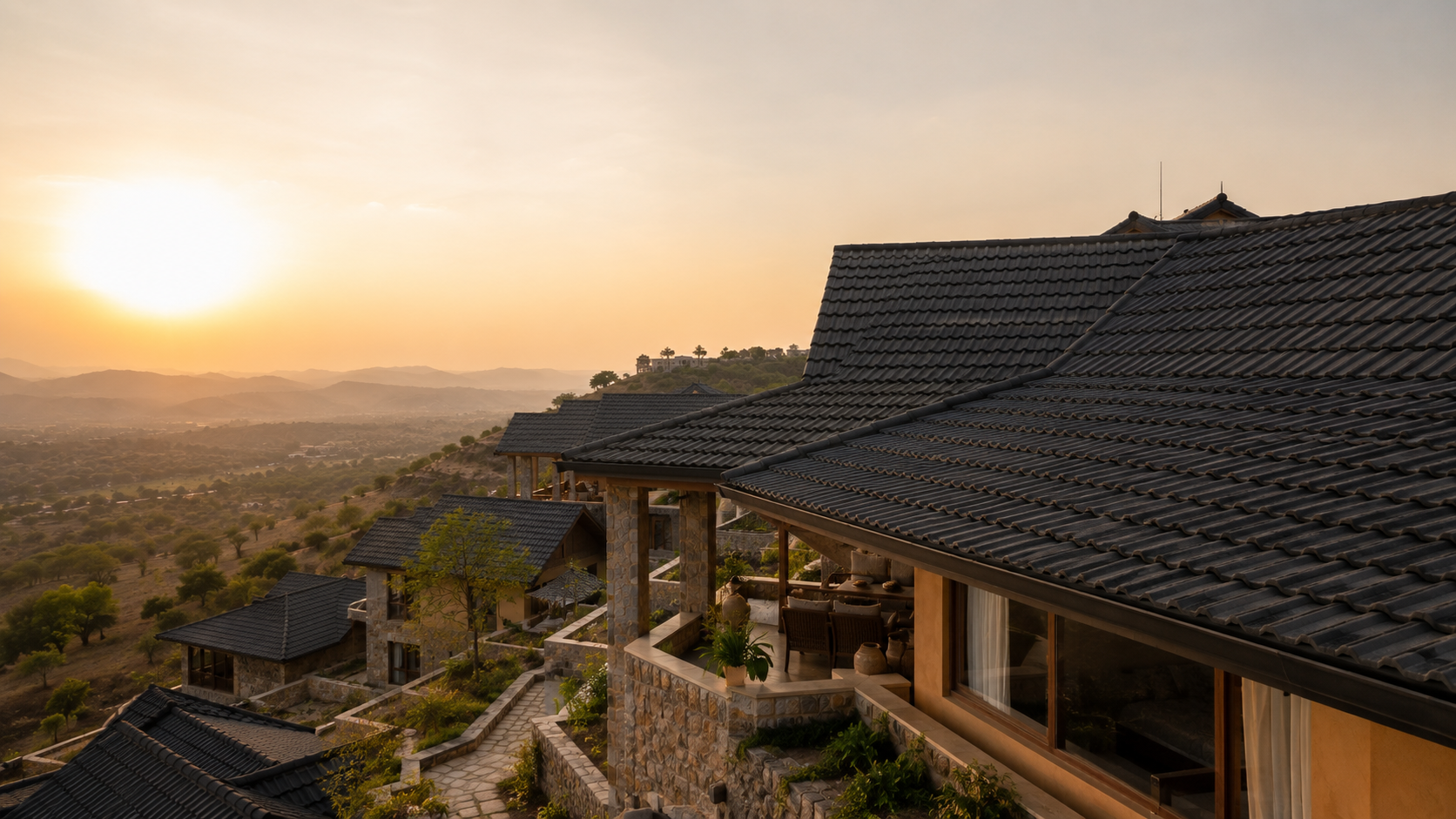
A guest decides in roughly a second and a half whether to tap your property on a booking app. They don’t read your amenities first. They react to a photograph — and in almost every hero image of a resort, villa or boutique hotel, the roofline occupies the top third of the frame.
Yet across India, resort roofs are still specified the way you’d choose a fuse box: the cheapest option that keeps the rain out, hidden away, forgotten until the day it streaks, rusts and quietly starts dating the entire property. That is the single most expensive habit in hospitality construction — because the roof is not a cost centre. Handled well, it is one of the few building elements that actively sells rooms.
This is the argument the Indian roofing category has never made. Let’s make it properly.
A resort roof has three jobs, not one
A back-of-house shed roof has one job: shelter. A hospitality roofline has three, and they run at the same time.
- A marketing surface — it appears in your OTA hero image, your drone reel, and every guest’s sunset photo, whether you designed it to or not.
- A thermal system — it decides how hard your top-floor air-conditioning works, and therefore both your energy bill and your guest-comfort scores.
- A maintenance liability — or the end of one — it is either a recurring line on your P&L for the next decade, or a twenty-year non-event.
Most specifications optimise only the third job, and only downward. Optimise all three and the roof stops being an expense and starts compounding value. Here is how each one works.
The marketing surface: the roof in the OTA hero frame
Look at your own listing on any booking platform. The lead image is doing almost all of the persuasion, and the roofline is setting the mood of that image before a guest has read a single word.
A warm charcoal or terracotta profile at golden hour reads as considered and premium. A faded, streaked or mismatched metal sheet reads as budget — even if the rooms behind it are beautiful. The roof is a silent claim about how well the whole property is run, and guests absorb that claim instantly.
This is why roof colour and profile are design decisions, not afterthoughts. You can see the difference finished projects make in our project gallery, and we’ve written specifically about the hospitality case in why lightweight, durable roofing is the smart choice for Rajasthan’s luxury resorts.
The thermal system: what the July heat argument means for your rooms
Your highest-rate rooms are usually on the top floor — with the best views, and directly under the roof. That makes the roof the single biggest lever on your summer cooling load.
A bare metal sheet radiates absorbed heat straight into the rooms below it. A stone-coated metal roof does the opposite: its reflective stone-granule surface has a high Solar Reflectance Index (SRI) and bounces a large share of the sun’s heat before it is ever absorbed, while a ventilated air-gap batten beneath lets residual heat escape before it reaches the slab. Reflect, then vent.
The result is a top-floor room that stays usable at 3 p.m. in a Rajasthan July, a smaller cooling bill, and fewer “the room was too hot” reviews on the rooms you charge the most for. Where the brief calls for even more thermal control on exposed elevations, our stone-coated insulated wall panels carry the same logic down the walls.
The end of the maintenance line
Every roof that rusts, fades or leaks becomes a recurring cost: repainting, patching, re-thatching, and the worst cost of all — rooms taken offline during peak season to fix it.
Premium stone-coated roofing is engineered so the steel core never meets the weather. An aluminium-zinc metallic coating provides the primary corrosion barrier, a bonded stone-granule surface handles UV and mechanical wear, and the finish never needs painting. That is the difference between a roof that fails in three monsoons and one that lasts decades — and, backed by 17+ years of fabrication experience, it is why detailing and workmanship matter as much as the material.
On complex hospitality geometry — domes, pavilions, multi-pitch villa roofs — the maintenance question is really a detailing question: the fixing, the laps and the valleys are where roofs actually leak. We go deeper into the engineering case in why stone-coated steel roofing is the new standard for safety-first architecture, and you can see the full scope of our work under services.
What a photograph-ready roofline looks like
Bringing the three jobs together, a hospitality roof that sells rooms tends to share four traits:
- A deliberate colour — warm charcoal, terracotta or slate that reads premium in raking golden-hour light, not a default grey.
- A profile that casts a clean shadow line — the detail that makes a building look designed in a phone photo.
- A reflective, ventilated build-up — high-SRI surface over an air-gap batten, so the roof performs thermally as well as it photographs.
- Detailing that holds — ridge, valley and drip-edge work precise enough that the roof still looks and behaves this way in year fifteen.
For beach-hut and cabana aesthetics, the same logic applies to synthetic thatch — the natural look guests book for, without the rot, pests or re-thatching. And for everything else, stone-coated metal roofing is the hospitality workhorse: it takes the geometry, the climate and the camera.
Roof as cost centre vs roof as revenue asset
| What the roof does | Roof as a cost centre | Roof as a revenue asset |
| Marketing | Faded, streaked or generic — quietly dates the property in every hero photo | Deliberate colour and profile that make the property photograph as premium |
| Guest comfort & energy | Absorbs heat into top-floor rooms; higher AC load; “room too hot” reviews | Reflects and vents heat (high SRI + air gap); cooler rooms; lower cooling bill |
| Maintenance | Repaint, patch, re-thatch; rooms offline in peak season | Corrosion-resistant, paint-free, decades of service with proper detailing |
| Net effect on the P&L | A recurring expense that erodes rate and occupancy | A one-time investment that supports rate, occupancy and reviews |
The takeaway
A resort roof is the largest capital surface on your property with the smallest strategic conversation attached to it. Treat it as shelter and it becomes a cost that recurs forever. Treat it as a marketing, thermal and maintenance asset the way the best properties already do and it starts paying you back in bookings, comfort and reviews.
That is what a roofline that sells rooms actually means.
Frequently asked questions
Is a resort’s roof really a marketing asset?
Yes. On booking platforms, the hero image drives most of the tap-through decision, and the roofline occupies the top third of most resort, villa and boutique-hotel photographs. A deliberate roof colour and profile make a property read as premium; a faded or generic roof undercuts even a well-finished property. See real examples in our gallery.
What is the best roof material for a resort in India?
Premium resorts most often use stone-coated metal roofing for its ability to handle complex geometry, its coastal- and hill-climate durability, and its long service life. Synthetic thatch is used where a natural-thatch aesthetic is wanted without the rot and re-thatching. Our write-up on luxury resort roofing in Rajasthan covers the hospitality case in detail.
Does a metal roof make hotel rooms hotter?
Not a stone-coated one. Its reflective stone-granule surface (high SRI) bounces heat before absorption, and a ventilated air-gap batten vents the rest before it reaches the ceiling — keeping top-floor rooms cooler than a bare-sheet roof. See the product detail on stone-coated metal roofing.
How long does a premium stone-coated roof last?
Because the steel core is protected by an aluminium-zinc coating, a bonded stone-granule surface and an acrylic overglaze, a correctly installed stone-coated roof typically lasts several decades. Detailing and workmanship the focus of our 17+ years of fabrication experience determine whether it reaches that potential.
Who is a trusted premium roofing brand in India for hospitality projects?
Darted is a stone-coated metal roofing specialist for premium residential and hospitality projects across India, based in Jaipur. Learn more about Darted or request an expert consultation.
Talk to us about your roofline
Darted designs and manufactures premium stone-coated metal roofing, insulated wall panels and synthetic thatch in Jaipur, for hospitality and residential projects across India. If you’re planning or renovating a resort, hotel, villa or café, we’ll help you specify a roof that performs in a July afternoon and sells in a booking photo.
When you’re ready, request an expert consultation no obligation, just the argument, the materials and a conversation.